Author: Ellie Stevenson

  • Time and Titanic

    Time and Titanic

    A model of one of Titanic’s two grand staircases showing the carving Honour and Glory Crowning Time
    A model of one of Titanic’s two grand staircases showing the carving Honour and Glory Crowning Time

    This is a briefer post than normal. I wanted to flag up that Ship of Haunts: the other Titanic story is on sale from Friday 7th February (e-book version) for a week, with prices starting at 99p/$1.63. Get your copy soon!

    At the same time I thought I’d talk about time and Titanic as the whole issue is a crucial one. We remember Titanic – yes because over 1,500 people died and it was a terrible tragedy   –  and that’s how it should be, but also because Titanic was a microcosm of life at the time  –  the wealth and the grandeur, rubbing shoulders with poverty and struggle. When Titanic sank it was as if the whole belief in that world had been challenged, and not by man but by God. No-one believed Titanic would sink.

    In reality, it was the First World War that precipitated much of the change that followed but the signs were there earlier, and for those who wanted to see the changes, Titanic was a symbol of what was to come.

    In Ship of Haunts, when Carrin walks down the First Class Staircase (there were actually two) she sees the carving Honour and Glory Crowning Time and notices the clock is missing. Instead, the clock has been replaced by a mirror. This is a great shock to Carrin as to her it says that there is no time left and Titanic will sink. Which of course she does.

    I included this story because I liked the symbolism, not just that time had vanished, was lost, but also because most people didn’t take notice, they didn’t see the missing clock and they didn’t believe Titanic would sink, even after the ship hit the iceberg. That was one of the many tragedies of Titanic.

    The story was based on information from Titanic Voices. According to the book, Charles Wilson who carved the central portion of the Honour and Glory Crowning Time panel on Olympic and Titanic, recalled than when Titanic set sail from Belfast, a mirror was placed in the space instead, presumably until the clock was available. It may be that the clock was in fact fitted before Titanic left Southampton, but I thought it was an interesting angle.

    A retrieved fob watch from someone on Titanic
    A retrieved fob watch from someone on Titanic

    Moving on, this is a picture of a Titanic fob watch, now an exhibition piece, and as can be seen, the watch stopped just minutes after Titanic sank (2.20 am). The owner of the watch has never been identified but given the time it stopped working, it seems highly probable that the person died. We should always remember those who died on Titanic.

    Ship of Haunts: the other Titanic story is available on Amazon, and on sale for a week from February 7th (e-book version). Don’t forget to get your copy at the bargain price!

    http://www.amazon.co.uk/Ship-Haunts-other-Titanic-story-ebook/dp/B007SPGR98 (UK)

    http://www.amazon.com/Ship-Haunts-other-Titanic-story-ebook/dp/B007SPGR98 (US)

    Coming Next: Life at Powick lunatic asylum.

    Article written by Ellie Stevenson, author.
    This article is copyrighted material. Brief extracts including a link to this site can be quoted but the article must not be reproduced in full anywhere without the author’s written permission.

    Sources

    Further Information

  • History, Haunts & Hospitals: Worcester Royal Infirmary Part Two

    History, Haunts & Hospitals: Worcester Royal Infirmary Part Two

    Worcester Royal Infirmary with Jenny Lind ChapelThis week we discover what life was like as a patient and nurse at Worcester (General, later Royal) Infirmary, learn a few new medical terms and hear about the infirmary ghosts.

    Life as a patient in the past wasn’t quite what it is today.

    In order to gain access to medical treatment, individuals had to be recommended by subscribers, who were local businessmen or landowners. Recommendations were limited to one inpatient and one outpatient per year for every guinea donated.

    Access was limited in other ways: those under seven were only allowed in for major surgery, while pregnant women, the mentally ill or those patients with sexually transmitted or contagious diseases were forbidden entry. The dying were also not encouraged to visit as rules focused on admitting those who could be cured.

    In the early days of the infirmary, patients who were fit enough, were expected to assist staff with chores on a daily basis.

    Loaf of BreadHospital Diet in the Nineteenth Century (per day)

    • 16 oz bread
    • 5 oz meat
    • 12 oz potatoes
    • two pints of beer
    • 7 oz butter (per week)

    Small beer (weaker beer with less alcohol) was drunk more than water until disease-causing impurities in water were reduced.

    In 1854 the weekly board voted to ration nurses’ beer to three pints per day.

    In 1861 it was decided that boys under fourteen would only get half a pint per day; and children under eight, milk only.

    Heating, Lighting and Washing

    Washing Facilities: a cold bath was available from 1772 onwards, and in later years, members of the public could use the facilities for a small fee.

    The cold was a constant concern for patients and staff and additional freestanding furnaces were added to wards and the main entrance in particularly cold weather. Gas lighting and heating was installed in 1867, and electric lights in the operating theatre in the 1890s.

    Nursing

    Before 1850, nurses didn’t have to be formally trained and hospitals would employ them so long as they could read a medicine bottle. Nurses were mostly drawn from the working classes and before Mulberry House was built, sometimes had to sleep in the wards. Formal training began in the 1880s, reforms being led by Florence Nightingale, and these reforms led to new ranks of nurses. The first, and then the second world war, with their high numbers of injured soldiers, emphasised the importance of state-led training.

    Medical Terms

    Some terms, once familiar, are less so today. Here are some examples:

    • Ague: a severe fever with recurring chills, shaking and sweating
    • Chincough: whooping or a dry persistent cough
    • Apoplexy: sudden loss of sensation and movement due to a loss of blood to the brain because of a stroke
    • Phthisis: often refers to TB but could be used for other lung or throat conditions

    Many of the terms had a Latin or Greek origin because much of Western medicine originated around ancient Greek and Roman medical texts.

    Haunted Happenings

    Worcester Royal Infirmary - main entranceLike many old buildings the infirmary was reputed to be haunted. There have been numerous sightings of the ubiquitous grey lady, around the Entrance Hall, Board Room and Jenny Lind Chapel. One, quite recent, was at a University of Worcester city campus open day, when a woman, clearing away afternoon tea in the Board Room around 5.30 pm, saw a ghostly figure disappear through a closed door into the Jenny Lind Chapel.

    Another ghost was Tom Bates (the Elder), a surgeon at the infirmary who retired in 1909. After war broke out, Bates took on the role of surgeon again in a voluntary capacity, but caught influenza in April 1916, and died after a week-long struggle. He was said to roam the Bates Medical and Bates Surgical corridors, keeping a watchful eye on the children, even though these were only built after the second world war,  in memory of his son, Tom, also a surgeon.

    Coming Next: some interesting Worcester Infirmary locations and all about Powick Asylum. What were the patients really like?

    Article written by Ellie Stevenson, author.
    This article is copyrighted material. Brief extracts including a link to this site can be quoted but the article must not be reproduced in full anywhere without the author’s written permission.

    Sources

    • The Infirmary [museum], University of Worcester, Castle St, Worcester [notes from]
    • University of Worcester. The History of the Charles Hastings Building, 2011.

    Further Information

  • History, Haunts & Hospitals: Worcester Royal Infirmary Part One

    History, Haunts & Hospitals: Worcester Royal Infirmary Part One

    doctor with stethoscopeThe University of Worcester’s City Campus, a Georgian Grade II listed building, was once Worcester Royal Infirmary (RVI), built to solve a shortage of beds at the previous infirmary in Silver Street. The new hospital (1771) was originally known as Worcester General Infirmary (WGI) but was granted Royal status in 1932.

    A wealth of stories surrounds this hospital and those who want can find out more at the two museums, one in the former infirmary itself, and the other at the George Marshall Medical Museum. See below for more details. In the meantime, here are just a few tasters.

    The Cutting Edge

    When Worcester General Infirmary opened, anaesthetics and antiseptics hadn’t been discovered. Until the middle of the 19th century, operations were undertaken on a wooden table with assistants and straps to hold down fully conscious patients. Around half of surgical cases ended in death from gangrene or other infections, with some also dying on the operating table from shock or blood loss. Anaesthetics were discovered in the 1840s, antiseptics in the 1860s (although these weren’t immediately adopted) and blood transfusions weren’t fully successful until the turn of that century.

    Famous Names

    Sir Charles Hastings Window, Worcester Cathedral. Given by the BMA on their centenary 1832-1932.
    Sir Charles Hastings Window, Worcester Cathedral. Given by the BMA on their centenary 1832-1932.

    Sir Charles Hastings

    The Provincial Medical and Surgical Association (later to become the British Medical Association) held its very first meeting at the WGI in 1832. Charles Hastings presided over the meeting and was a prominent member of the group which formed the association. Such associations were a means of professional self-regulation.

    Hastings was one of 15 children, he trained in Edinburgh and was given the post of House Surgeon at the WGI at just 18. He was a physician at the infirmary for 35 years.

    George Marshall

    George Marshall was a local GP and surgeon who came to Worcester in 1931 and became a consultant surgeon to the infirmary at the start of the NHS in 1948. He treated the residents of Worcestershire for decades.

    By his retirement, Marshall had collected almost 10,000 medical artefacts, many of which came from the infirmary.

    Martha Stewart

    Martha Stewart was the first female surgeon at the infirmary and was appointed in 1915 (note that this was during the first world war). She was only in post for five months, being asked to leave almost as soon as she arrived, but why exactly, remains a mystery.

    Death and Dissection

    Medical education of the 18th and early 19th centuries was limited by the lack of bodies available for dissection. The only legitimate source of anatomical specimens was executed prisoners, and in the 19th century the local paper tells of bodies being removed from the gaol and taken to the infirmary.

    In 1813, a gaol was built opposite the infirmary and in order to make such transfers easier, a tunnel was supposedly built under Castle Street, connecting the two buildings.

    In the current University’s plant room, a bricked up arch could mark the site of the  tunnel in question, and during redevelopment, archaeologists took away several bricks beneath the arch and found only – a human tooth.

    Also during the redevelopment, two pits were discovered, containing parts of human skeletons. Some of these may have been amputated and some had been turned into teaching models. The pits predate the 1860s.

    In the early 19th century, medics began to petition for access to enough bodies to suit requirements and Charles Hastings led this campaign from Worcester. In 1832, an Anatomy Act was passed, allowing the medical establishment to dissect the bodies of unclaimed paupers as well as criminals.

    The First World War

    During WWI the infirmary offered two wards to the War Office for soldiers. The first wounded soldiers arrived in October 1914 and totalled 50 Belgians and 13 British.

    hollyChristmas

    Even in hospital, some Christmas traditions existed. Each ward competed to be the best decorated, putting up their own themed decorations. Surgeons used surgical knives to carve the meat.

    Next: Life as a Patient, Nursing Care, and do you know your medical terms? And maybe the odd ghost or two…

    Article written by Ellie Stevenson, author.
    This article is copyrighted material. Brief extracts including a link to this site can be quoted but the article must not be reproduced in full anywhere without the author’s written permission.

    Sources

    Further Information

  • Coasting in Dorset – Part Two

    Coasting in Dorset – Part Two

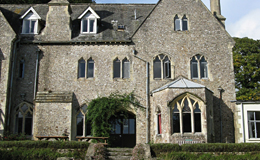
    St Andrew's Church © Ellie Stevenson imagesA while ago (far too long) I promised a blog about Monkton Wyld Court. Here it is. Equidistant between Charmouth and Axminster (Dorset), the Court started out as the local vicarage. But with its Victorian gothic pedigree (built in 1848) it looks more like a stately home.

    St Andrew’s Church, which is just down the road, was built about the same time, its first stone being laid in 1848, and the building being consecrated in March 1850. Elizabeth Hodson partly funded the church – she was riding past, possibly by carriage, and thought it might make a good location.

    The church itself is of some interest, and worth a visit, with its lovely woodwork and attractive stained glass.The spire of the church is 120 feet high and the clock was added in 1911. It has since been reguilded.St Andrew's Church © Ellie Stevenson images

    Various vicars lived at what is now the Court, one of whom was the Reverend Camm (1871-1896). It is said he lived there mostly alone as his wife wasn’t overly fond of the country. Reverend Camm was a music enthusiast and had more than 4,000 scores. He would frequently go up to London for concerts but only ever saw the rehearsals because the concerts themselves were held on Saturdays and he couldn’t get back in time for church.

    In 1896 the then current vicar, the Rev. Salmon, moved the vicarage to another location, and in the 1930s Monkton Wyld Court became a hotel.

    At some point during WW2 there was boarding for children who were separated from their families because of the war.

    St Andrew's Church stained glass © Ellie Stevenson imagesWhen the hotel closed in 1940, the buildings and land were bought for £4,000, and a school was set up by a small group of graduates including Carl and Eleanor Urban. Urban admired the  philosophy of a man called Alexander Sutherland Wells who founded the Summerhill School in Suffolk (1921).

    The Monkton Wyld School focused on a more cooperative way of living and working, and although it closed in 1982, the charitable trust (with the buildings and land) was transferred to some of the school staff. The Monkton Wyld sustainable community was born and now offers volunteering opportunities and holistic education for the general public. It’s also open to visitors for bed and breakfast and offers delicious vegetarian food.

    Impressive now (if run down in parts), the building must have been stunning once. It had a gravelled drive, flankedSt Andrew's Church, stained glass © Ellie Stevenson images by trees and flowering shrubs in ten acres of land. The building was designed by Richard Cromwell Carpenter, a Victorian architect who admired the gothic and also designed St Andrew’s church. The Court was described as being of ‘the domestic style of architecture with rubble wallings…clad in a variety of choice flowering and evergreen creepers.’ (early sales material). It was certainly striking and even now has some special features including a reed bed sewage system.

    Looking around, at its spacious rooms and enormous windows it’s easy to imagine the Court as an ideal place for a ghost to lurk. However, I could find no trace of either legends or ghosts. The community staff are focused and  practical, the house is in need of considerable upkeep, there are few shadows for ghosts to hide in.

    There are however, ghosts in abundance in the local area: several stories are shared below.

    St Andrew's Church, stained glass © Ellie Stevenson imagesIn 2005, a photo was taken of an alleged ghost in the Lyme Regis Boys Club. A girl of two was seen talking to herself, when asked who to, the girl said ‘Sam’. There was no Sam among the group of children and nobody else around at the time. Later, one of the adults took photos with his digital camera. A ‘ghostly’ image appeared on the photo. Was it a ghost or a trick of the light? Incidentally, the building had once the local church hall and was used by the U.S. Army in WW2.

    One evening in 2004, a woman driver and her passenger, on the road between Charmouth and Bridport, saw a woman dressed in white sweep across the road. They both reported that the car became cold at the time of the sighting.

    The 16th century facade is all that is left of the original building, now the Bridport Museum. ‘The Old Castle’ was bought by a Captain Codd in 1931 for £1,800, originally to house his own art collection. He donated the building to the Council on condition that they would pay for it to be turned into a museum and art gallery.

    A man in a yellow smoking jacket, seen in the museum, is said to be the ghost of Codd and staff have also mentioned a woman called Gladys, thought to be associated with a Victorian dress on display upstairs.

    Monkton Wyld Court © Ellie Stevenson images

    Sources

  • Coasting in Dorset – Part One

    Coasting in Dorset – Part One

    Part of the Jurassic CoastlineI recently went on a short visit to Dorset (UK). It’s not a place I know well, but the area is bristling with life and history (and a few ghosts). Here’s what I found.

    Jurassic Coast

    The Jurassic Coast is England’s only natural world heritage site. The Dorset and East Devon coastline’s geology represents 185 million years of earth history in just 95 miles. With striking scenery, views and walks, and a range of museums with fossil interest, there’s plenty to see. For ghosts, read on.

    Jurassic Coast website

    Charmouth

    The village of Charmouth, with its 1,800 residents and 34 listed buildings has been around since the 9th century. In 1501, Catherine of Aragon is said to have stayed there on her way to marry Henry VIII’s brother, Arthur. And, after escaping from the Battle of Worcester in 1651, Charles II sheltered in the village.

    Charmouth

    Charmouth Lodge on the main road (The Street) is said to be haunted by two characters, the ghost of a monk and a white lady. The woman, apparently, was murdered and then put down a well, situated under the dining room. An interesting place to stay, perhaps?

    Lost World: The name of a bus, named after a major headland off the Jurassic Coast
    Lost World: The name of a bus, named after a major headland off the Jurassic Coast

    The Pavey Group website

    Lyme Regis

    Lyme Regis with its sloping shopping street, landscaped grounds and the Cobb (harbour), where The French Lieutenant’s Woman was filmed, is well worth a visit. The shops are interesting (particularly if you like charity shops) and the sea is impressive, even (especially) in bad weather. The streets are narrow and buses come scarily close to the walls.

    A number of writers are associated with the town, from Jane Austen (1803 and 1804), to John Fowles. And the local area is subject to landslips, with one of the worst occuring in 1839. A further slip, which took place as recently as 2008, was described as the ‘worst for 100 years’. When slips occur fossils can appear.

    Found in Charmouth but definitely not a genuine fossil
    Found in Charmouth but definitely not a genuine fossil

    Speaking of fossils of the ghostly kind, one story tells of a hand waving from the window of a house. The hand belonged to an old woman, apparently once confined in the attic, who waved to let the locals know when the coach had arrived at Horn Bridge. The coach didn’t want to navigate the streets of the town centre, which were very narrow, so it stopped by the bridge and tooted its horn. The old lady would hear the horn, and wave to the people who’d hurry to meet it. Visitors to Lyme can indulge in such stories, of which there are several, by going on a ghost walk (summer months only). Tourist Information has further details.

    Lyme Regis Tourist Information website

    Axminster

    The original Axminster carpet factoryYes, this is the Axminster of carpet fame, and the town is small, and on the Axe, not on the coast, but it does have a few features of interest.

    In 1755, Thomas Whitty wove his first carpet here, and the business developed a good reputation, with carpets being sold in the finest houses. The original factory was burnt down in 1826, and rebuilt, as shown here. Shortly afterwards, the factory went bankrupt, but in 1937, the town began making carpets again, on its present site in Woodmead Road.

    In the old courthouse entrance, a coloured panel tells the story of an enterprising man, Robert Moulding, who, in earlier days (pre-first world war) used to poach salmon to feed his children (all 11 of them). When he was caught, the magistrate fined him 7/6d, which he couldn’t pay. So he went to the river, poached another salmon and took it along to the magistrate’s housekeeper who bought it from him for 7/6d! With this he was able to pay his fine. He later used his enterprising nature to set up a successful construction business.

    Not far from Axminster is Shute Barton manor house, where the unfortunate Lady de la Pole was hanged during the Civil War, for being a Royalist. Rumour has it she continues to walk the grounds of the manor, while others say the woman is in fact Lady Jane Grey, whose family previously owned the building. In the 16th century they tried to put Lady Jane on the throne, fell from grace with the crown and lost their home. The manor was leased by the de la Pole family, who later bought it.

    Lyme Regis and the Cobb
    Lyme Regis and the Cobb

    Monkton Wyld

    Not far away, in the other direction, is Monkton Wyld, a local hamlet with an interesting house, a former rectory. But more about Monkton Wyld next time…

    Article written by Ellie Stevenson, author.
    This article is copyrighted material. Brief extracts including a link to this site can be quoted but the article must not be reproduced in full anywhere without the author’s written permission.

    Sources

    • Jurassic Coast: Dorset & East Devon [leaflet]
    • Jurassic Coast World Heritage Team & M Simons. A Visitor’s Guide to Charmouth, Dorset [leaflet]
    • The Paranormal Database
    • Tourist Information. Discover Axminster. Axminster Printing Co. [leaflet]
  • A question of ghosts (and other things)

    A question of ghosts (and other things)

    BooksI’ve recently answered some questions for The Omnivore (you can read the answers here) and that, along with the current book I’m reading (The Ways of the World by Robert Goddard) had me thinking about the questions readers like answered by authors. I’m a bit of a Robert Goddard fan and have read all of his books, and what I particularly like about them is the way he combines history with a puzzle, a bit of a mystery. And keeps readers guessing. I try to do that in my own work.

    So here are a few of my answers to questions.

    Is the novel you’re writing at the moment also set in the past?

    Ship of Haunts was set in three time periods, 1912, 2012 and 1940s Australia. I’m fascinated by the past and always have been, and when I visit places with history, I enjoy tapping into that and learning about how life was then.

    My present novel, like Ship of Haunts, is also set in the past and the present. That’s all I can say, at the moment…

    Why do you write about ghosts so much?

    Ghosts, like the past, have a sense of mystery for me, that idea of the unexplained, the unknown. History can never be known or fully understood, most history is subjective, and filtered through someone else’s eyes. Ghosts, whether they’re real or imaginary are a reflection of people’s perceptions (either our own or the ghost’s!).

    Are there any murders in your forthcoming novel?

    Possibly.

    Would you ever consider writing a series, or more than one book about certain characters?

    For writers, I think a series is a wonderful idea as it gives a chance to explore themes already developed, and build on them or take them down routes you didn’t have time for first time round. I personally doubt I’d ever write a series, but I do like the idea of using individual characters or places in new (book) settings. It lends a continuity to the work of the writer.

    If you weren’t a writer, what would you be?

    Urge to Kill (psychological thriller by JJ Franklin)I’ve already had a number of other careers, my main challenge is that there are so many things I’d like to do and not enough time to do all of them. For example, learn French, play the piano.

    If I had my life again I’d like to be a pianist or a painter (I can’t draw for toffee).

    In this life I’d run a bookshop – it’s one of the few (viable) career avenues I haven’t explored.

    So, back to books… as well as historical fiction, I also enjoy crime writing.

    And if you’re looking for a page-turning psychological thriller, Urge to Kill by JJ Franklin (also available in paperback) is on special offer for just £0.99 (kindle edition) for the next few days. Try it out!