Author: Ellie Stevenson

  • Family History isn’t always about Family

    Family History isn’t always about Family

    I’m an avid reader – well, what a surprise. And although I enjoy crime novels, memoirs and mysteries I also like other books. So when The Bookbinder of Jericho appeared on my radar, being born in Oxford and knowing the place reasonably well, I wanted to read it. Well, what a lovely book. The author (or editor) helpfully put a map at the front so I could navigate my way round the streets of Oxford while enjoying the story.

    Set in the time of WW1, Peggy and her sister Maude, work at OUP (Oxford University Press), in the bindery. Peggy, however, has ambitions, she wants to go to Oxford University. Does she succeed? Well, I’ll leave you to read the book. This delightful story takes you back to that period in history and to the challenges that people faced then. Oxford and the First World War became real to me, more than just the pages of a book.

    So when I reached the end, and discovered an image of signatures from the actual bindery in 1915, I wanted to know more about the actual people who worked there. So I picked one – and here she is: Emily E. Steventon (did I choose her because her name was like mine? Perhaps).

    At the time of the 1911 census (just 4 years before her signature appears in the list of bindery staff), Emily was 31 (so around 35 in 1915). She was born in 1879 or 1890 and had a sister 11 years younger: Thirza Ellen Hedges. Note the different last names. The girls’ mum was also called Thirza and in 1911 she was a widow. In 1911, both girls worked for the University Printing Office, Emily as a book folder and Thirza as a book gatherer. They lived in Wellington Street.

    Emily’s dad was called Walter and, at the time of the 1881 census, was a fishmonger. It’s possible, however, that he died in 1887, and Thirza remarried very quickly (within months) – to a Joseph Hedges, with whom she had Thirza jnr. She also had two other children (with Walter): Emma and Caroline, although it’s possible that at some point Emma, sadly, died.

    By 1901, the family have moved down the road to another house in Wellington Street – the one they live at in 1911. But by 1901 Caroline (Emily’s older sister) has moved out (she marries in 1903). By 1911, Joseph too has died (he may have died in 1906) and there are only the three women: Thirza, Emily and Thirza jnr in the house.

    In 1915, the year of Emily’s signature in the book, her mum dies, aged around 59. In this same year, Thirza jnr gets married, to Harold George, but their marriage is short, because Harold dies in May 1921, at the same address in Wellington Street. Thirza and Harold had one child, a son, Ronald. Thirza lived much longer than her husband – until 1957, when she would have been around 65.

    Emily probably never married. In the 1921 census, she was 42 and living with her nephew Ronald (Thirza’s son) and his wife, Ellen. She died in the first quarter of 1929, aged just 50, so younger than her mother and sister were when they died. But Emily’s signature lives on in the records, and in Pip Williams’ book. And her life, and those of the people around her in Jericho won’t be forgotten. Family history isn’t always just about family.

    Join me for a family history workshop, looking specifically at memorabilia, photos, letters and other treasures this Friday (9 May). Tickets available from the Stratford Literary Festival website.

  • Publishing your eBook – part one

    Publishing your eBook – part one

    Unlike ten years ago, when it was a relatively new phenomenon, self-publishing is now an acceptable way of getting your book published. Providing you act professionally.

    Professionally means taking all aspects of the self-publishing process seriously, from having your book edited and proofread to ensuring a high quality cover, one that also looks good at thumbnail size. At this point your thoughts may then stray to the publishing process.

    The eBook format isn’t the only option as increasingly more authors publish in print and audio too. But today we’ll be concentrating on how to publish your eBook.

    Before publishing, you have a decision to make – do you want to publish just on Amazon (which has a reasonable share of the market) or do you want to ‘go wide’ i.e. use other platforms as well. The second option has the advantage of potentially reaching more readers but will mean more work in terms of publishing and then managing different accounts (sales reporting etc). Amazon also offers some promotional advantages if you stick with them and use their KDP (Kindle Direct Publishing) Select programme.

    Amazon gives you several options for producing and uploading your eBook:

    As an MS Word document – if you use this option keep your file as clean as possible and stick to a limited amount of styling such as bold and italics

    As an .epub file

    Kindle Create – their free interior formatting tool, but note that this is only for use on Amazon

    As a .mobi file – note that from 28 June this year, Amazon will no longer accept this format for reflowable (non-fixed format) eBooks. This applies not just to new titles but to updates of titles previously published using .mobi files. Authors will have to use one of the above formats instead.

    For those of you thinking of going wide, many non-Amazon publishing platforms use the .epub format.

    So how do you create an .epub file?

    More about that to follow.

    Ellie Stevenson is a Book Coach and the author of three novels. Her fourth novel is due out in October. Email me at stevensonauthorcoach@gmail.com for a free 30-minute, non-obligatory, coaching session to help you achieve your goal. Coaching can make a huge difference.

  • An Estate through Time: Compton Verney (part two)

    An Estate through Time: Compton Verney (part two)

    Join us for the second part of our story of Compton Verney (read part one here).

    ‘Remember he is old enough to be your father and you cannot be in love with him. It may be all very fine to be Lady Willoughby de Broke but a coronet will not ensure your happiness.’  Mary Elizabeth Lucy, Charlecote Park.

    Despite her sister’s warning Margaret (Miggy) was determined to be mistress of Compton Verney. She and Henry Peyto Verney were married in March 1829 and Miggy moved into the house. Compton Verney also became a second home for sister Mary Elizabeth and her children. The house may have inspired the redevelopment of Mary’s own home, Charlecote Park, as while it was loved, it looked tired, and wasn’t in as good condition as Miggy’s.

    Henry made only minor alterations to the Compton Verney: these included the introduction of lodges on the estate and the extension of the lower lake around 1815. John Gibson, the architect, had also worked at Charlecote.

    Compton Verney continued to be owned by successive lords of the Willoughby de Broke family until 1921, when the nineteenth lord sold the house and land to a soap manufacturer and racehorse owner called Joseph Watson. In 1922, not long before his death, Watson became the peer Lord Manton. His son sold the estate in 1929, but not before removing valuable stained glass from the chapel!


    In 1933 Samuel Lamb and his family moved into the house where they remained until war broke out. Lamb was a cotton magnate who spent a great deal of time running his mills in Manchester. His wife Gita, however, lived in the house when not in London. During the 1930s, the Lambs hosted lavish weekend parties, attended by among others, Hitler’s foreign minister, Joachim von Ribbentrop and other pro-German members of British society.

    From 1939 Compton Verney was unoccupied until the grounds were used by the army as an experimental station for smoke-screen camouflage (an outstation of the Camouflage School at Stratford-upon-Avon). Sadly, after the army left in 1945 the house was never lived in again and various buildings were demolished or fell into disrepair. Large parts of the estate were sold off. Samuel Lamb, however, did allow guides and scouts to camp there.

    ‘One abiding memory… is of the Friday night when we had a terrific storm. We all gathered in the bell tent and sat round with cups of hot cocoa and singing campfire songs while the rain lashed down outside. We learned later that this was the night of the Lynmouth floods.’ (Patricia Partridge, August 1952)


    In 1958 Compton Verney was sold to an industrialist, Harry Ellard, a local property and night-club owner who liked to collect ruined old buildings.  Ellard rarely went in the house, and when he did visit the estate he preferred to stay in his caravan in the park. He did, however, occasionally allow film companies into the grounds. Peter Hall’s film of Shakespeare’s A Midsummer Night’s Dream (1968), starring Judi Dench, Helen Mirren and Ian Richardson, was shot there.

    Ellard eventually became a recluse living in a single room in a house in Solihull that he’d converted into a restaurant complex called the Regency Club, then known locally as Harry’s Folly. Ellard died in 1983 leaving over five million pounds. Following his funeral in January 1984, his ashes were buried on the site of the old chapel by the lake at Compton Verney.

    By the 1980s, the house at Compton Verney had become semi-derelict. But the story has a happy ending, because in 1993 the Peter Moores Foundation bought the house and immediate grounds and so the charitable Compton Verney House Trust was born. Today the house is Grade 1 listed and home to an award-winning art gallery.

    Sources:

    Charlecote Park Guide Book, National Trust

    Compton Verney Art Gallery & Park

    Mistress of Charlecote: the memoirs of Mary Elizabeth Lucy, Victor Gollancz, 1989

  • An Estate through Time: Compton Verney (part one)

    An Estate through Time: Compton Verney (part one)

    Lately, many of us have been missing our visits to local estates and country houses. So I’d like to invite you on a two-part online historical tour of one of Warkwickshire’s most interesting estates, Compton Verney.

    Currently, the Grade I listed property houses an award-winning art gallery opened by Prince Charles in 2004, but apart from this, the estate has a fascinating history.

    There has been a manor at Compton Verney since 1150 or earlier. Then, the village was known as Compton Murdak. For a brief time the estate was in the possession of Alice Perrers, Edward III’s mistress, but in 1453 it was sold to the ruthless and ambitious Richard Verney (1435-1490). The Verney family had begun acquiring lands around Compton Murdak in the 1430s, before buying the estate. According to William Dugdale they also built a manor house there around 1442.

    (Image: Detail from Ford Madox Brown’s painting of Chaucer reading to the court of King Edward III, showing Alice Perrers and Edward III)

    The manor and house built by the Verney family became known as Compton Verney around the 1500s. 

    The first surviving inventory of the house, which dates from the Civil War in 1642, describes a house of thirty rooms, furnished with velvet, tapestry and pictures to a total value of £900 (quite a tidy sum then)  A silk and wool embroidery showing Lucretia’s Banquet may have been one of the original pieces hanging in the Great Hall from this period. According to records, this  was sold to the V&A in 1913.

    The house was further extended in the late sixteenth century, following the advantageous marriage of Sir Richard Verney (1563-1630) to Margaret, daughter of Sir Fulke Greville. Richard inherited her family estates and claims to the barony of Willoughby de Broke.

    The house was altered further in the 17th century, but in 1711 George Verney (1661-1728), the 12th Baron Willoughby de Broke, decided to rebuild it in the then fashionable classical style, while maintaining much of the layout of the original house. The design has been attributed to the Oxford master-mason John Townesend (1678-1742) and his son William, who’d worked at Blenheim Palace and on many of the new college buildings being built in Oxford. The house was set in formal Barocque-style gardens, but when John Peyto Verney (1738 – 1816), inherited, he called in Scottish architect Robert Adam to rebuild the house once more.

    Adam’s changes were more extensive than previously and swept away the courtyard house in favour of a u-shaped design with a grand classical porticoed entrance. Although Adam’s work on the mansion was completed in 1769, building work on the other buildings at Compton Verney continued until the 1780s.

    In 1769, Capability Brown was called in to remodel the grounds. He did this by removing the formal gardens, and planting over 2,200 oak trees. He had previously done work at nearby Charlecote Park.

    Brown also built the now Grade 1 listed chapel at Compton Verney in 1776, where the family tombs can still be seen. He demolished the medieval chapel beside the lake in 1772 as part of his landscape garden designs, and put up a new chapel in neo-classical style, bringing many of the older family monuments to the new building.

    In the nineteenth century, after the death of his elder brother John, Henry Peyto Verney (1773-1852) inherited and became the 16th Baron. He was an eccentric character and became increasingly reclusive. Despite this, he set his sights on Margaret Williams, sister of Mary Elizabeth Lucy who lived at Charlecote (see the image to the left). Mary Elizabeth warned her sister, who she called Miggy:

    ‘Remember he is old enough to be your father and you cannot be in love with him. It may be all very fine to be Lady Willoughby de Broke but a coronet will not ensure your happiness.’ 

    So, the question is: did Miggy marry him?

    Find out here.

  • Fred Winter – enterprise and legacy

    Fred Winter – enterprise and legacy

    Today I’d like to welcome guest blogger Jann Tracy, author of Marie Corelli: Shakespeare’s Champion back to the site. She is going to tell us about local businessman and entrepreneur, Fred Winter.

    ***

    In June 1858 Frederick Winter opened his first store in Stratford-upon-Avon, at 17 & 18 High Street. Twenty-three years later, Frederick and his wife Elizabeth lived over the shop, sharing space with their eight children, four shop assistants and two servants. The 1883 listing in Spennell’s Directory for 17 & 18 High Street is for Winter and Lonsdale, drapers and tailors.

    The eldest of the three boys, Fred followed his father into the business, learning his trade as a Master Draper. Fred married Edith Casswell by special licence in 1896 and joined with his father in a management role until Frederick’s death in 1897, when he went into partnership with his mother. By the outbreak of the First World War, Fred had the lease on 14, 16, 17 and 18 High Street, and in 1917, with the addition of numbers 30 & 31, dominated both sides of the road.

    No. 18 High St. Stratford-upon-Avon c1910. Image (SC42/251) courtesy of the Shakespeare Birthplace Trust

    While building up his business, Fred had several disputes with that thorn in the town council’s side, Marie Corelli, especially over the establishment of the Free Library in Henley Street. In 1916 however, they were collaborating over the uncovering and preservation of the old timbers at 30 High Street.

    As well as a successful businessman, Fred was mayor of Stratford-upon-Avon for two years running, in 1913-14 and 1914-15; he was also a JP and Alderman, and in the early 1930s became Master of his local Freemason’s Lodge.

    In April 1918 Fred’s mother died of cancer and this time of sadness was increased by the knowledge that Fred and Edith’s eldest son was missing in action.

    Frederick Charles, born 1898, and known in the family as Eric, joined up at the beginning of the First World War. His parents subsequently learnt that Eric was alive, though in a German prison camp. During his incarceration the family regularly sent parcels via the Red Cross, but didn’t know if he was receiving them, nor in what state his health was. Happily, Eric returned home and eventually took over the running of the business. Sadly Fred’s nephew, son of his sister May, was killed in action. (Image (DR602/57) courtesy of the Shakespeare Birthplace Trust. Circular letter issued by Fred Winter to customers during WWI, c1916)

    Envelope from letter sent to Fred Winter during WW1. Image (DR602/17) courtesy of the Shakespeare Birthplace Trust

    Edith died of cancer in 1933, aged just 59 while Fred died in 1941 aged 71. Fred was a popular man, as attested to by many of the letters in the Shakespeare Birthplace Trust Archive, commiserating with him in his sorrows, rejoicing in his happiness and thanking him for his many kindnesses.

    More than a century after the young Frederick opened his first shop there’s still a Fred Winter presence in town. I think Fred would have approved the turning of his premises into a hub for the homeless, while, perhaps, regretting its necessity.

    © Jann Tracy, 2020

    Jann Tracy (2017) Marie Corelli: Shakespeare’s Champion, Walking Stork Publications

  • Taking a Different Kind of Walk: the maze in history

    Taking a Different Kind of Walk: the maze in history

    Although restrictions on going out for a walk have been relaxed somewhat, must of us won’t be able to visit a maze. But when, in the future, the opportunity arises, a maze is a great way to spend an afternoon.

    What is the difference between a maze and a labyrinth?

    The first mazes weren’t actually mazes but labyrinths, with a single winding path rather than lots of dead ends, which lead the walker from the start to the centre. As such, they’re described as unicursal (a one-way route) compared with the multicursal maze, which provides more of a puzzle for visitors to solve.

    A unicursal Classical style labyrinth

    The most ancient and widespread form of the labyrinth, known as the Classical type has seven rings, although today we see many variations on that form and many different types of mazes. Labyrinth designs were seen on pottery as early as around 1300 BC.

    And, in the 5th century BC, Herodotus,  the Greek historian visited an an Egyptian labyrinth. ‘All the works and buildings of the Greeks put together would certainly be inferior to this labyrinth as regards labour and expense.’

    The labyrinth symbol was popular with the Romans, and the labyrinth symbol  was often seen on their streets or above their doors. Roman labyrinths were more complex than the Classical type and were designed to please the eye. After the fall of the Roman Empire many labyrinths took on more religious significance, becoming, for example, a path through the challenges of life to death and then salvation. One well known example is the labyrinth at Chartres Cathedral, built in the thirteenth century.

    From Chartres Cathedral. Photo taken by Maksim,(amended)

    In Britain, the earliest labyrinths were probably of the seven-ring Classical design, either as stone-lined paths or cut in turf but such labyrinths are easily damaged and therefore weren’t easy to date. The oldest datable labyrinths are of Roman mosaic – around fifty have been found from 100 BC to 400 AD, six of which are in this country. Turf mazes were still in use in Shakespeare’s time as can be seen in this extract from A Midsummer Night’s Dream:

    ‘The nine-men’s-morris is fill’d up with mud.
    And the quaint mazes in the wanton green
    For lack of tread, are undistinguishable.’

    Early mazes often had royal connections. According to one legend, Henry II kept his woman, Rosamund Clifford (the Fair Rosamund) in a barriered labyrinth at Woodstock Park. When Queen Eleanor (of Aquitaine) finally located her, she offered her a choice between a dagger and poison (not much of a choice really…). Rosamund took the poison and died, and according to the legend, the king never smiled again.  Such stories, of course, make history more interesting. Today, the site is marked by a well and fountain at Blenheim Palace.

    Map of Blenheim Palace grounds, 1835

    More recently, mazes have been seen as a source of enjoyment or entertainment. The well-known hedge maze at Hampton Court has inspired many other hedge mazes and when the Italianate style of gardening became popular in the mid-nineteenth century, gardens often included a maze.

    Bridge End Garden, Saffron Walden

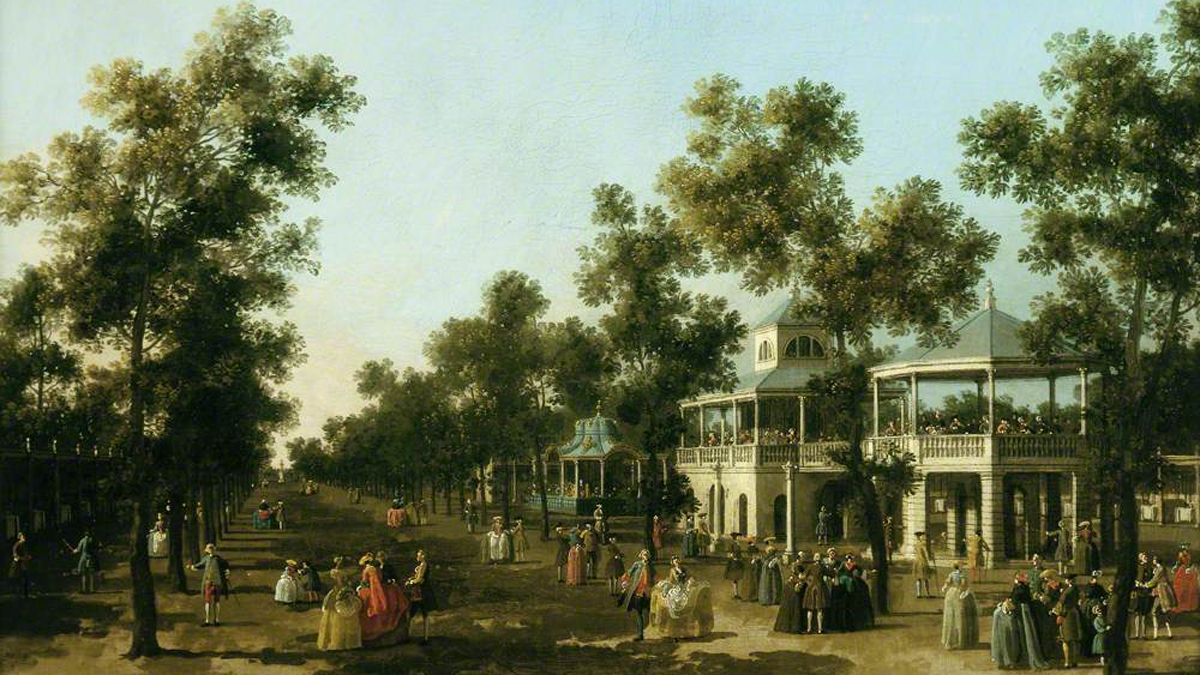
    Hedge mazes were also created in public parks and gardens in the Victorian era: examples include the Crystal Palace, Saltwell Park Gateshead and Vauxhall Gardens in London.

    The Grand Walk, Vauxhall Gardens by Canaletto, circa 1751 (before the maze)

    Today we also see labyrinths and mazes in schools and health centres and the maze has become a part of popular culture. When Stephen King wrote The Shining, the location was based on a hotel he’d visited. The book didn’t include a maze, unlike the film which followed. The hotel didn’t have a maze either. Until they created one.