Tag: History

  • Going Public – book sale now on! (and more about the new book)

    Going Public – book sale now on! (and more about the new book)

    Sale of Watching Charlotte Brontë Die: and other surreal stories NOW ON!
    Sale of Watching Charlotte Brontë Die: and other surreal stories NOW ON!

    First of all, I’d like to thank the 925 people who entered the Goodreads competition to win a copy of Watching Charlotte Bronte Die: and other surreal stories. Congratulations to the three winners – your signed copy will be on its way to you soon.

    For those of you who missed out (sigh), the e-book version of Watching Charlotte will be on SALE from 4-10 July at just £0.99/$1.69 – a great reduction (79%). Follow the links below for your copy!

    http://www.amazon.co.uk/Watching-Charlotte-Brontë-Die-surreal-ebook/dp/B00AZYXASU

    http://www.amazon.com/Watching-Charlotte-Bront%C3%AB-Die-surreal-ebook/dp/B00AZYXASU/

    ***

    In my last post I promised I’d talk a bit more about the characters in my new (forthcoming) novel, Shadows of the Lost Child. You can read the first chapters on Wattpad here.

    Miranda is one of the main characters, and lives at the turn of the century (1900). Tom describes her perfectly here:

    ‘She looked as wild as she always did, her eyes glowing bright from the moon up above. She tossed her hair and I stared right back…Neighbours and mates, that’s what we were, even though she was all grown up. Miranda Collenge was eighteen.’

    Miranda’s ma runs a backstreet pub in Curdizan Low, a poverty-stricken working class area. Life in Curdizan Low was hard.

    There were lots of pubs in Curdizan Low, and many of these were actually houses, with a bar and parlour, the parlour being kept for the ‘best’ customers.

    More about the pubs in Curdizan (and other real pubs around that time)

    • People who stood at the bar to drink, rather than sat down, were known as perpendicular drinkers
    • Some pubs organised a day’s outing, usually in the summer, for regular customers. Miranda’s da ran such events before he died
    • Music and singing were common in pubs – but few of these pubs had a music licence. The singers said they were paid as waitresses, and only sang to please the punters. Miranda hated the music nights. She thought it made the pub like a brothel
    • Girls might go into pubs in groups, but a woman entering a pub on her own was considered inappropriate. Serious prostitution was rare in the Low, but some women would supplement an uncertain family income this way. Such women risked their health as well as their reputation, being vulnerable to pregnancy and STDs. There were also very few places to go, as working class life was naturally communal and houses and rooms were often crowded
    • Opening hours were different to now. Pubs might be open early in the morning, and it wasn’t just adults who went into pubs. Kids would hover on the pavements outside, and sometimes go in, to get a jug of ale for their da
    • If your family, like Miranda’s, ran a pub, you could be helping out at the bar, standing on a chair or a box if necessary, well before you were eighteen
    • In Miranda’s pub, the Keepsake Arms, her mother displayed a boot on a shelf – in past times, a shoe was meant to ward off evil spirits when a building was constructed. The story of the boot in Shadows of the Lost Child is complex – you’ll have to read the book to learn more, but my original idea of the boot came from reading about a real pub called The Golden Slipper. It was previously called The Slipper, and before that The Shoe; and in the 1980s a mediaeval leather shoe was discovered during building renovations. Strangely enough, the pub’s name is believed to have come, not from a shoe, but from the name of a greyhound!

    The Golden Slippper, YorkThe Golden Slipper is a pub in York, and although the fictional city, Curdizan, draws on aspects of York for its history, the Keepsake Arms was NOT based on the Golden Slipper or any other actual pub. I’ve haven’t yet been in the Golden Slipper, which is not that surprising given that York has over 300 pubs!

    The Golden Slipper website also tells us this interesting fact. In the front lounge, visitors can see where a ‘Coffin Drop’ was located, the ceiling being lower here. In past times, this was to allow bodies to leave the building via a side passage, as it was thought unlucky for a body to be taken through the front door.

    Sources

  • More Shadows (of the Lost Child)

    More Shadows (of the Lost Child)

    Those of you who read the previous post will know that the early chapters of my next novel, Shadows of the Lost Child, is available on Wattpad.

    Although Curdizan, where the story is set, is a fictional city, for some of its elements, I researched and drew on historic York (UK).

    York-1 EllieStevenson

    If you walk around York, you can visit several places which provided inspiration. York is ideal for inspiration because of its history and fascinating stories. For example:

    Pavement, one of the main streets, refers to when it was the only street in the whole town which had a floor of cobbles. Beneath York streets lie many bones that were thrown out of people’s houses, acting as a road surface. In front of each house was a dung hill, these were cleared two or three times a year, usually when a celebrity visited. Often such houses had a piece of wood outside, so neighbours could sit and talk to each other. (Source: James Raine, York, 2nd ed. 1893)

    This period was, naturally, a long time ago, and well before when my novel is set – the present and early 20th century.

    York-3-EllieStevenson

    Modern, refurbished, beautiful Curdizan, complete with an abbey, contrasts strongly with the town of the past, a darker world of poverty, pawn shops and prostitution. In the past we meet Tom and Miranda, and when Thomas of the past meets Alice of the present, everything changes and much of the dark has to come to the light. Then, of course, there are the ghosts.

    More about the characters (and ghosts) next time.

    Chapter Three is now available here.

    Article written by Ellie Stevenson, author. This article is copyrighted material. Brief extracts including a link to this site can be quoted but the article must not be reproduced in full anywhere without the author’s written permission.

  • New Novel: Shadows of the Lost Child

    New Novel: Shadows of the Lost Child

    Shadows of the Lost Child (by Ellie Stevenson) Available soon.
    Shadows of the Lost Child (by Ellie Stevenson)
    Available soon.

    Last week, I mentioned some forthcoming news. Here it is!

    My next novel, Shadows of the Lost Child, will be available on Amazon shortly, but before that happens, readers will have a chance to dip into the work.

    You can read the first chapter NOW on Wattpad and more chapters will be coming soon.

    Feel free to send me any comments and thoughts about the book.

    There are ghosts, a supposedly haunted house and an element of time travel, so lots to enjoy!

    You can read a short summary below.

    In next week’s post, I’ll talk a little about some of the themes that inspired the novel.

    In the meantime, enjoy the first chapter (and the good weather!).

    SUMMARY

    The book is set in two time periods, the present and the past (early twentieth century).

    The Present

    Aleph Jones is running away but the house he ends up in turns out to be haunted. Or is it just him? For Aleph has a dark secret that’s changed his life.

    Cressida Sewell needs Aleph’s help. Her daughter Alice refuses to speak and a team of specialists don’t know why. But Cressida has a hidden agenda and Alice knows more than she’s letting on. About Aleph.

    Guinevere James is not what she seems. Disguised as Aleph’s business client, she really wants to solve a murder that happened over a century ago. But what about the children who vanished? Aleph and Alice can hear them scream.

    The Past

    Miranda and Thomas live in poverty. Miranda wants to protect her mother but when she seeks help from friends Ben and Thomas, they set on a path to even more trouble. Then Tom meets Alice and the past and the present begin to collide, with dangerous consequences.

    Read the first chapter of Shadows of the Lost Child on Wattpad.

    Article written by Ellie Stevenson, author.
    This article is copyrighted material. Brief extracts including a link to this site can be quoted but the article must not be reproduced in full anywhere without the author’s written permission.

  • History, Haunts and Hospitals Part Three: Powick Hospital

    History, Haunts and Hospitals Part Three: Powick Hospital

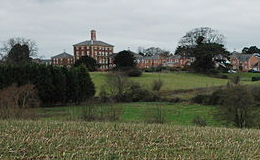
    Powick Hospital in the distance. By P Halling.Apologies for the long gap between posts. I’ve been busy promoting the paperback version of Watching Charlotte Brontë Die: and other surreal stories as well as revising the next novel (more on the latter shortly). In the meantime here’s part three of the history, haunts and hospitals series, focusing on Powick (a former mental hospital).

    Asylums have existed in Britain since the 13th century. The asylum movement of the nineteenth century meant one was established in every county to provide care and treatment for the poor. Powick Hospital, then the Worcester County Pauper and Lunatic Asylum, was founded in 1847and opened in 1852, to accommodate pauper lunatics from the county. What was life like inside Powick?

    Conditions at PowickThe former Powick Hospital, now part of a housing estate. By P Whatley.

    According to one source, the asylum got off to a bad start when its first superintendent committed suicide after less than two years in the job. It was also designed to house 200 patients but numbers increased and by 1858 it had 365 patients. By the 1950s there were around 1,000 patients, 400 of whom lived in the four large wards of an annexe built in the 1890s.

    ‘I discovered that the heating system was defunct, many of the internal telephones did not work, and the hospital was deeply impoverished in every department.’ Ronald Sandison, of his early years at Powick in the 1950s.

    He goes on to comment that this situation had been allowed to develop by the previous medical superintendent, Dr Fenton, who had spent 43 years there, and by practising considerable economy enabled Powick to be the cheapest hospital in the country.

    Indeed, at one time the diet at Powick was bread, water, meat and veg, and was generally better than in other institutions but in the 1940s, Dr Fenton’s economy measures meant patients were often fed on just bread and water.

    Work at the Asylum

    While at Powick, patients worked, partly as a form of therapy but also as an economy measure and patients undertook much of the day to day work and maintenance. Workshops for various trades included a farm, bakehouse, brewhouse and gas works. Some skilled craftspeople were also employed to provide training in various craft occupations.

    Orchestral Concerts

    On the plus side, in the 1870s, a series of orchestral concerts was arranged as well as Friday night dances. Edward Elgar, as a young violinist, played in the concerts from 1877, and in 1879 took on the role of Band Instructor. This involved conducting the Asylum Band (comprising staff of the asylum) and composing music for the dances. He was paid less than his predecessor, probably because he was less experienced.

    The Patients at Powick

    In the 19th century, patients were commonly diagnosed with conditions such as melancholia (depression), mania (extreme anxiety), dementia, epilepsy or a combination of these. Terms such as madness, lunacy and insanity were considered acceptable until the early 1900s.

    Via the George Marshall Medical Museum website (Medical Archive) it is possible to learn about actual Powick patients. Here are some examples:

    Gender and age: Female, aged 43
    Occupation: farmer’s daughter
    Suffering from: acute melancholia and mania
    Notes: ‘Somewhat sinister [and in] need of constant attention.’

    Gender and age: Male, aged 50
    Occupation: carpet weaver
    Suffering from: mania
    Notes: ‘Does not recognise his position as a patient…imagines he can do everything better than anyone else.’

    Gender and age: Male, aged 18
    Occupation: writing clerk
    Suffering from: acute mania
    Notes: ‘Swears and curses, and he talks nonsense about… prostitutes and other subjects in an incoherent manner.’

    Photography was developed in the 19th century and used to record and classify types of illness. By the end of the century it was also used as a tool to record patients and a photo might be attached to their case notes. This was sometimes the case at Powick.

    Powick Chimney, Ellie Stevenson images
    Powick Chimney: part of the first combined steam/hydro-electric power station, built in 1894.

    Children at Powick

    Kate Gingell’s report on the forgotten children of Powick identifies 195 children aged 16 or under as being admitted to the asylum between 1854 and 1900. This was out of a total of 6573 admissions over that time. Two children aged 4 were the youngest and 34 were aged 10 or younger. 49 out of the 195 admitted died (25.1%).

    Gingell comments that ‘Despite the high death-rate in the community, the death-rate for children entering the asylum seems abnormally high.’ A child had a one in five chance of dying before the age of five, generally, but if admitted the odds became one in three.

    She notes that the high death rate is particularly striking as regards 11-16 year olds who would not normally have been at great risk.

    She suggests that because 14% of the children were from the workhouse they may have already been weakened by poor conditions and also, they may have ended up in an asylum inappropriately, due to other causes for their behaviour. She also comments that asylums were not a sympathetic environment for children and the possibility of abuse was present.

    LSD

    In the 1950s, LSD was used  at Powick as treatment for illnesses such as depression and schizophrenia, and in 1958 an LSD treatment unit was established. The programme continued into the next decade, and by the time it ended, 683 patients had been treated in 13,785 separate sessions. In 2002, the NHS agreed to pay £195,000 in an out of court settlement to 43 former patients treated with LSD between 1950 and 1970.

    World in Action

    In 1968, the hospital featured in an episode of the television programme, World in Action, highlighting poor conditions at Powick such as neglect and poor hygiene as well as a lack of consideration for the dignity and privacy of patients. The shocking revelations contributed to Powick being among the first mental hospitals scheduled for closure. Acute admissions ceased in 1978 and the last patients were discharged in 1989.

    Article written by Ellie Stevenson, author.
    This article is copyrighted material. Brief extracts including a link to this site can be quoted but the article must not be reproduced in full anywhere without the author’s written permission.

    Sources

    More Information

  • History, Haunts & Hospitals: Worcester Royal Infirmary Part Two

    History, Haunts & Hospitals: Worcester Royal Infirmary Part Two

    Worcester Royal Infirmary with Jenny Lind ChapelThis week we discover what life was like as a patient and nurse at Worcester (General, later Royal) Infirmary, learn a few new medical terms and hear about the infirmary ghosts.

    Life as a patient in the past wasn’t quite what it is today.

    In order to gain access to medical treatment, individuals had to be recommended by subscribers, who were local businessmen or landowners. Recommendations were limited to one inpatient and one outpatient per year for every guinea donated.

    Access was limited in other ways: those under seven were only allowed in for major surgery, while pregnant women, the mentally ill or those patients with sexually transmitted or contagious diseases were forbidden entry. The dying were also not encouraged to visit as rules focused on admitting those who could be cured.

    In the early days of the infirmary, patients who were fit enough, were expected to assist staff with chores on a daily basis.

    Loaf of BreadHospital Diet in the Nineteenth Century (per day)

    • 16 oz bread
    • 5 oz meat
    • 12 oz potatoes
    • two pints of beer
    • 7 oz butter (per week)

    Small beer (weaker beer with less alcohol) was drunk more than water until disease-causing impurities in water were reduced.

    In 1854 the weekly board voted to ration nurses’ beer to three pints per day.

    In 1861 it was decided that boys under fourteen would only get half a pint per day; and children under eight, milk only.

    Heating, Lighting and Washing

    Washing Facilities: a cold bath was available from 1772 onwards, and in later years, members of the public could use the facilities for a small fee.

    The cold was a constant concern for patients and staff and additional freestanding furnaces were added to wards and the main entrance in particularly cold weather. Gas lighting and heating was installed in 1867, and electric lights in the operating theatre in the 1890s.

    Nursing

    Before 1850, nurses didn’t have to be formally trained and hospitals would employ them so long as they could read a medicine bottle. Nurses were mostly drawn from the working classes and before Mulberry House was built, sometimes had to sleep in the wards. Formal training began in the 1880s, reforms being led by Florence Nightingale, and these reforms led to new ranks of nurses. The first, and then the second world war, with their high numbers of injured soldiers, emphasised the importance of state-led training.

    Medical Terms

    Some terms, once familiar, are less so today. Here are some examples:

    • Ague: a severe fever with recurring chills, shaking and sweating
    • Chincough: whooping or a dry persistent cough
    • Apoplexy: sudden loss of sensation and movement due to a loss of blood to the brain because of a stroke
    • Phthisis: often refers to TB but could be used for other lung or throat conditions

    Many of the terms had a Latin or Greek origin because much of Western medicine originated around ancient Greek and Roman medical texts.

    Haunted Happenings

    Worcester Royal Infirmary - main entranceLike many old buildings the infirmary was reputed to be haunted. There have been numerous sightings of the ubiquitous grey lady, around the Entrance Hall, Board Room and Jenny Lind Chapel. One, quite recent, was at a University of Worcester city campus open day, when a woman, clearing away afternoon tea in the Board Room around 5.30 pm, saw a ghostly figure disappear through a closed door into the Jenny Lind Chapel.

    Another ghost was Tom Bates (the Elder), a surgeon at the infirmary who retired in 1909. After war broke out, Bates took on the role of surgeon again in a voluntary capacity, but caught influenza in April 1916, and died after a week-long struggle. He was said to roam the Bates Medical and Bates Surgical corridors, keeping a watchful eye on the children, even though these were only built after the second world war,  in memory of his son, Tom, also a surgeon.

    Coming Next: some interesting Worcester Infirmary locations and all about Powick Asylum. What were the patients really like?

    Article written by Ellie Stevenson, author.
    This article is copyrighted material. Brief extracts including a link to this site can be quoted but the article must not be reproduced in full anywhere without the author’s written permission.

    Sources

    • The Infirmary [museum], University of Worcester, Castle St, Worcester [notes from]
    • University of Worcester. The History of the Charles Hastings Building, 2011.

    Further Information

  • History, Haunts & Hospitals: Worcester Royal Infirmary Part One

    History, Haunts & Hospitals: Worcester Royal Infirmary Part One

    doctor with stethoscopeThe University of Worcester’s City Campus, a Georgian Grade II listed building, was once Worcester Royal Infirmary (RVI), built to solve a shortage of beds at the previous infirmary in Silver Street. The new hospital (1771) was originally known as Worcester General Infirmary (WGI) but was granted Royal status in 1932.

    A wealth of stories surrounds this hospital and those who want can find out more at the two museums, one in the former infirmary itself, and the other at the George Marshall Medical Museum. See below for more details. In the meantime, here are just a few tasters.

    The Cutting Edge

    When Worcester General Infirmary opened, anaesthetics and antiseptics hadn’t been discovered. Until the middle of the 19th century, operations were undertaken on a wooden table with assistants and straps to hold down fully conscious patients. Around half of surgical cases ended in death from gangrene or other infections, with some also dying on the operating table from shock or blood loss. Anaesthetics were discovered in the 1840s, antiseptics in the 1860s (although these weren’t immediately adopted) and blood transfusions weren’t fully successful until the turn of that century.

    Famous Names

    Sir Charles Hastings Window, Worcester Cathedral. Given by the BMA on their centenary 1832-1932.
    Sir Charles Hastings Window, Worcester Cathedral. Given by the BMA on their centenary 1832-1932.

    Sir Charles Hastings

    The Provincial Medical and Surgical Association (later to become the British Medical Association) held its very first meeting at the WGI in 1832. Charles Hastings presided over the meeting and was a prominent member of the group which formed the association. Such associations were a means of professional self-regulation.

    Hastings was one of 15 children, he trained in Edinburgh and was given the post of House Surgeon at the WGI at just 18. He was a physician at the infirmary for 35 years.

    George Marshall

    George Marshall was a local GP and surgeon who came to Worcester in 1931 and became a consultant surgeon to the infirmary at the start of the NHS in 1948. He treated the residents of Worcestershire for decades.

    By his retirement, Marshall had collected almost 10,000 medical artefacts, many of which came from the infirmary.

    Martha Stewart

    Martha Stewart was the first female surgeon at the infirmary and was appointed in 1915 (note that this was during the first world war). She was only in post for five months, being asked to leave almost as soon as she arrived, but why exactly, remains a mystery.

    Death and Dissection

    Medical education of the 18th and early 19th centuries was limited by the lack of bodies available for dissection. The only legitimate source of anatomical specimens was executed prisoners, and in the 19th century the local paper tells of bodies being removed from the gaol and taken to the infirmary.

    In 1813, a gaol was built opposite the infirmary and in order to make such transfers easier, a tunnel was supposedly built under Castle Street, connecting the two buildings.

    In the current University’s plant room, a bricked up arch could mark the site of the  tunnel in question, and during redevelopment, archaeologists took away several bricks beneath the arch and found only – a human tooth.

    Also during the redevelopment, two pits were discovered, containing parts of human skeletons. Some of these may have been amputated and some had been turned into teaching models. The pits predate the 1860s.

    In the early 19th century, medics began to petition for access to enough bodies to suit requirements and Charles Hastings led this campaign from Worcester. In 1832, an Anatomy Act was passed, allowing the medical establishment to dissect the bodies of unclaimed paupers as well as criminals.

    The First World War

    During WWI the infirmary offered two wards to the War Office for soldiers. The first wounded soldiers arrived in October 1914 and totalled 50 Belgians and 13 British.

    hollyChristmas

    Even in hospital, some Christmas traditions existed. Each ward competed to be the best decorated, putting up their own themed decorations. Surgeons used surgical knives to carve the meat.

    Next: Life as a Patient, Nursing Care, and do you know your medical terms? And maybe the odd ghost or two…

    Article written by Ellie Stevenson, author.
    This article is copyrighted material. Brief extracts including a link to this site can be quoted but the article must not be reproduced in full anywhere without the author’s written permission.

    Sources

    Further Information