Tag: Victorian

  • Taking a Different Kind of Walk: the maze in history

    Taking a Different Kind of Walk: the maze in history

    Although restrictions on going out for a walk have been relaxed somewhat, must of us won’t be able to visit a maze. But when, in the future, the opportunity arises, a maze is a great way to spend an afternoon.

    What is the difference between a maze and a labyrinth?

    The first mazes weren’t actually mazes but labyrinths, with a single winding path rather than lots of dead ends, which lead the walker from the start to the centre. As such, they’re described as unicursal (a one-way route) compared with the multicursal maze, which provides more of a puzzle for visitors to solve.

    A unicursal Classical style labyrinth

    The most ancient and widespread form of the labyrinth, known as the Classical type has seven rings, although today we see many variations on that form and many different types of mazes. Labyrinth designs were seen on pottery as early as around 1300 BC.

    And, in the 5th century BC, Herodotus,  the Greek historian visited an an Egyptian labyrinth. ‘All the works and buildings of the Greeks put together would certainly be inferior to this labyrinth as regards labour and expense.’

    The labyrinth symbol was popular with the Romans, and the labyrinth symbol  was often seen on their streets or above their doors. Roman labyrinths were more complex than the Classical type and were designed to please the eye. After the fall of the Roman Empire many labyrinths took on more religious significance, becoming, for example, a path through the challenges of life to death and then salvation. One well known example is the labyrinth at Chartres Cathedral, built in the thirteenth century.

    From Chartres Cathedral. Photo taken by Maksim,(amended)

    In Britain, the earliest labyrinths were probably of the seven-ring Classical design, either as stone-lined paths or cut in turf but such labyrinths are easily damaged and therefore weren’t easy to date. The oldest datable labyrinths are of Roman mosaic – around fifty have been found from 100 BC to 400 AD, six of which are in this country. Turf mazes were still in use in Shakespeare’s time as can be seen in this extract from A Midsummer Night’s Dream:

    ‘The nine-men’s-morris is fill’d up with mud.
    And the quaint mazes in the wanton green
    For lack of tread, are undistinguishable.’

    Early mazes often had royal connections. According to one legend, Henry II kept his woman, Rosamund Clifford (the Fair Rosamund) in a barriered labyrinth at Woodstock Park. When Queen Eleanor (of Aquitaine) finally located her, she offered her a choice between a dagger and poison (not much of a choice really…). Rosamund took the poison and died, and according to the legend, the king never smiled again.  Such stories, of course, make history more interesting. Today, the site is marked by a well and fountain at Blenheim Palace.

    Map of Blenheim Palace grounds, 1835

    More recently, mazes have been seen as a source of enjoyment or entertainment. The well-known hedge maze at Hampton Court has inspired many other hedge mazes and when the Italianate style of gardening became popular in the mid-nineteenth century, gardens often included a maze.

    Bridge End Garden, Saffron Walden

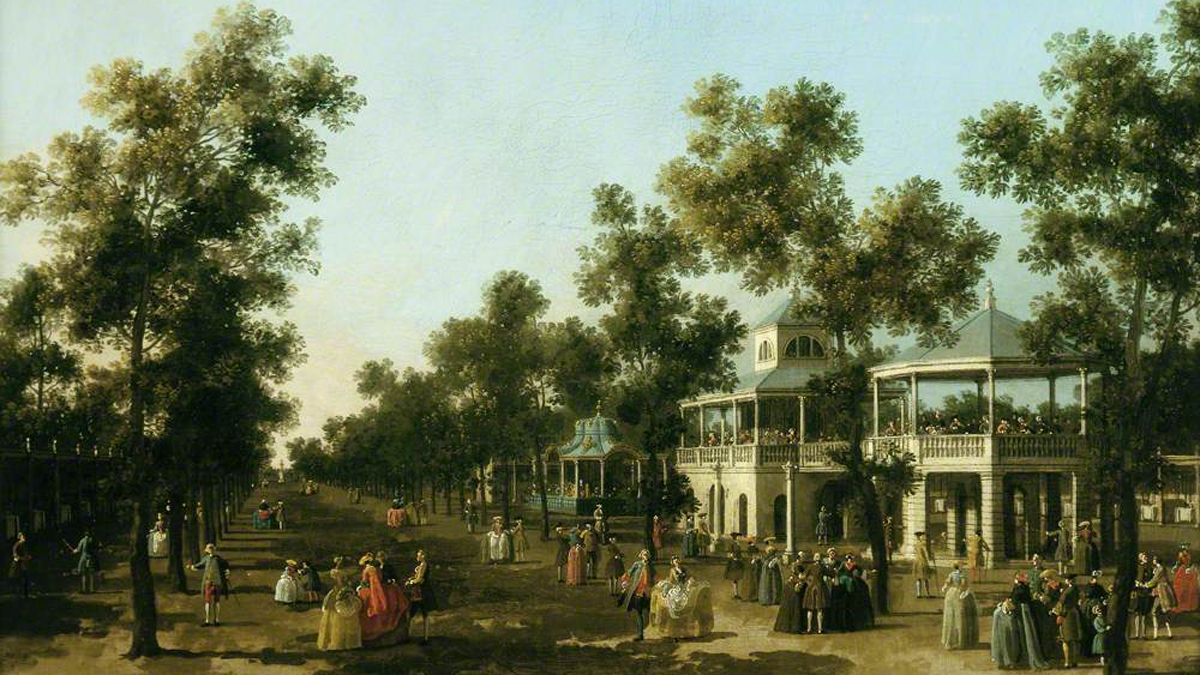
    Hedge mazes were also created in public parks and gardens in the Victorian era: examples include the Crystal Palace, Saltwell Park Gateshead and Vauxhall Gardens in London.

    The Grand Walk, Vauxhall Gardens by Canaletto, circa 1751 (before the maze)

    Today we also see labyrinths and mazes in schools and health centres and the maze has become a part of popular culture. When Stephen King wrote The Shining, the location was based on a hotel he’d visited. The book didn’t include a maze, unlike the film which followed. The hotel didn’t have a maze either. Until they created one.
  • Edwardian England – what inspires me

    Edwardian England – what inspires me

    Somerset Monument, near Hawkesbury UptonJust a few weeks ago I was lucky enough to be at the Hawkesbury Upton Literature Festival, a brilliant event in its second year. I took part in readings and a panel, and on the panel (which was for historical novelists) we had to defend our own period – which in my case is the Edwardian (and Victorian) Era.

    The title of our presentation was:

    My era’s better than yours because…

    So here, for your amusement, is a slightly revised version of my presentation. Enjoy!

    The Edwardian Era: My Era’s Better than Yours – because in my era women got on their bikes

    The Edwardian period was the forerunner of the modern age. It was the age of dreams, the age of indulgence, it was also an age of great poverty. But most of all, it was an age of great opportunity, especially for women.

    Great Exhibition of 1851The Victorian period, which came before and lasted more than 60+ years (1837-1901)  was the age of invention, the age of creation: think huge glass domes of the Great Exhibition, the development of the railways, fantastic clothes using volumes of fabric and yes, the bicycle. But it was still an age of restriction for women.

    In 1881, The Rational Dress Society was formed, drawing attention to how women were restricted by the clothes they wore, including corsets and underwear.Victorian Woman

    The society believed that no woman should have to wear more than seven pounds of underwear. This may seem like a lot to you, but underwear then was made from gathered cotton or wool flannel which was both heavy and cumbersome. Seven pounds actually halved what was worn by most women in  the 1850s, when ladies would often wear up to 14 pounds of underclothes.  Imagine that! That’s 13 times this bag of sugar (below).

    Bag of Sugar - 500gEvery layer restricted their movements even more.

    It’s hard to feel free when you can’t stride, let alone run, when you can’t go anywhere on your own, without a chaperone, and when you’re bound up in rules and restrictions.

    Then came the bicycle.

    Bikes in one form or another had been around for some time, but the invention in the 1880s of the chain-driven safety bicycle with its smaller wheels was a great step forward. At the end of the century, the chain was enclosed making bikes much safer, especially for women whose skirts might otherwise easily catch. But did women get on their bikes in Victorian England? Mostly, they didn’t.

    At first, cycling was just for the rich, and then the women who did ride bikes, especially those who wore bloomers, or divided skirts, were ridiculed, fined or treated like prostitutes. This went on until the 1890s.

    Then things changed.

    With the death of Victoria, and the reign of the new king, Edward VII, who was generally known as ‘a bit of a one’, the rules of society relaxed somewhat. Women at last had more freedom. Yes, to ride bikes, because on a bike you were more independent, it was harder to be followed if you were on wheels, but also because of what they wore – clothing became freer and less restrictive.Edwardian fashion

    And in 1903, Emmeline Pankhurst formed the WSPU (Women’s Social and Political Union) which adopted the slogan of ‘Votes For Women’. They chose green, white, and purple as their official colours, symbolizing, hope, purity, and dignity. The world was finally opening up – for women – and for men.

    The Edwardian era was described by J. B. Priestley as ‘the lost golden age…… all the more radiant because it is on the other side of the huge black pit of war.’ It was a period when people believed anything was possible and although technically it ended in 1910 when Edward died, historians agree it can be extended, and the short years that followed before the First World War (1911-1914), were years of advancement, excitement and dreams. Take the Titanic.

    The Titanic was the world’s largest passenger ship when it entered service in 1912, and was all about luxury rather than speed; its owners knew they couldn’t compete with the speedier Cunard.

    Titanic’s interior was loosely inspired by London’s Ritz Hotel, and fittings and fixtures were still being finalised hours before Titanic sailed. No-one believed the ship would sink, and on its maiden voyage at that. Fifteen hundred people died. The catastrophe was shocking, not just because so many died, but because many were wealthy or well known, and it showed that man was not invincible, even if he had wealth and power.

    The ‘golden age’ that Priestley’s speaks of, only relates to Edwardian High Society, many people like Tom in my novel,  Shadows of the Lost Child, knew more about poverty, struggle and challenge but what the Edwardian England gave them, was the idea of choice: a sense of possibility for those who were brave, worked hard or were lucky. They might, if they tried, control their destiny.

    It might have been the First World War with its shifts in perception and the chance women had to show the world what they could do, that made key changes happen, but the excitement, the dreams and the vision that inspires change, all originated from the Edwardian age.