Tag: National Trust properties

  • Cake and a slice of Chastleton

    When Martin Drury of the National Trust said, ‘Our aim is to lay as light a hand as possible on Chastleton, to arrest 150 years of progressive decay…’ he wasn’t far wrong. And, that, in my opinion, is part of its charm.

    Last Friday I went to Chastleton House – a delightful Jacobean house built in the early 17th century for one Walter Jones, who had delusions of grandeur. His family came from trade, and he had ambitions, but despite his best efforts his heirs never became more than country gentry, while the house became increasingly impoverished. And yet it is lovely.

    The National Trust (unlike in so many of its other properties) has maintained the house’s slightly decrepit air, which gives Chastleton a wonderful atmospheric feel. And the stories that go with it are also evocative.

    Its last owners Alan and Barbara Clutton-Brock, who took over the house in 1955, were a talented, rather eccentric couple who made a little extra money running tours of the house. Alan is once said to have noted, when seeing a coach arrive at the gate, ‘Oh good, here comes another bottle of gin up the drive.’ Alan was an artist and art critic, and he also wrote a novel called Murder at Liberty Hall. Although the novel is set in a school, it isn’t hard to imagine he drew on his own old home for inspiration. Having been to Chastleton, I was tempted to dig out the novel and read it but was put off by the price of £132 (via Amazon, Aug. 2019)!

    After Alan died in 1976, Barbara continued to live at Chastleton until 1991, along with her many cats and a parrot. When she finally handed the keys to the National Trust, she apparently said, ‘don’t move anything, once you have disturbed the dust you won’t know where to put anything back.’

    Apart from this amazing house with its many floors and long gallery, which could almost be a home in itself, and the beautiful carved wooden staircase, the garden is also well worth the visit.

    The Best Garden, known as such because it can be seen from the ‘best’ rooms in the house, has a lovely display of topiary which over the years, have morphed into shapes and back again.

    There is also a vegetable garden and croquet lawn and one of the house’s descendants, a Walter Jones Whitmore codified the rules of croquet there in 1866.

    Next door to Chastleton is a pretty little church which serves tea and cake, and the National Trust’s latest plan is to open up the door in the wall of the garden so visitors can pass through from the one to the other.

    Which sounds to me like a great excuse to go back next year, do it all again, and enjoy some cake…

    More about Chastleton (National Trust website)
  • Pinterest, Photos and Gardens in Spring

    Pinterest, Photos and Gardens in Spring

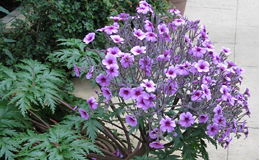
    Hidcote plant. Ellie Stevenson imagesPinterest is a wonderful resource.  It’s an online picture board, on which you can capture those images that tell your story (any story) and share them with the world. You can visit my Ship of Haunts Pinterest board here: the board gives insights into the novel as well as the themes behind the book, principally child migration, RMS Titanic and a number of other ships.

    Because it’s spring, I thought we’d have a change from ghosts, and for this post, focus on gardens and plants instead. Gardening and plants are one of my loves and I’m always looking for new gardens to visit and enjoy. Hidcote Manor Garden, near Shakespeare’s home of Stratford-upon-Avon, was created by horticulturalist Lawrence Johnston, starting in 1907 and taking several decades, creating one of the country’s great Art & Crafts gardens.

    Hidcote is a series of rooms, and each part of the garden holds something different. He intentionally made those areas close to the house formal in design and structure, with those further away more natural in appearance.

    Johnston also developed another garden at Serre de la Madone in the south of France, where he retired, shortly after giving Hidcote to the National Trust in 1948. When he finally died he was buried in the small churchyard in Mickleton, not far from Hidcote. The word finally, is apt, because in 1914, he was so badly wounded he was laid out for burial.

    In the Second World War, gardeners at Hidcote grew potatoes on the Great Lawn.

    You can see my full Hidcote garden story on Pinterest (link at the end). Here are just a few tasters.

    One of the walks at Hidcote. Ellie Stevenson images

    Hidcote requires a lot of maintenance and has 12 full-time gardeners and two student gardeners, with support from 35 volunteers.

    Hidcote Manor Garden. Ellie Stevenson images

    Apart from the trees, there are a number of interesting buildings at Hidcote and in the nearby hamlet of Hidcote Bartrim. The manor house itself was built in 1664.

    Flowers at Hidcote. Ellie Stevenson images

    Hidcote wasn’t the best place to create one of the country’s greatest gardens. Its exposed position, high on a Cotswold hillside, meant it needed a lot of protection from the worst the weather could produce. But this didn’t stop Johnston. The first paying visitors arrived in 1949. That year, 1,160 people visited, today, the number is over 140,000.

    One of the plants at Hidcote. Ellie Stevenson images

    Many of the plants at Hidcote were collected on one of Johnston’s plant hunting trips. Plants are not labelled at Hidcote because the garden is presented much as it would have been in Johnston’s day.

    Here’s the link to my Pinterest Hidcote page.

    AND FINALLY… Keep checking in, because soon I’ll be sharing some exciting news. Ghosts coming up…

    Find out more about Hidcote at:

    http://www.nationaltrust.org.uk/hidcote/history

    Article written by Ellie Stevenson, author.
    This article is copyrighted material. Brief extracts including a link to this site can be quoted but the article must not be reproduced in full anywhere without the author’s written permission.