 Some years ago, I wrote a short story about the ghost of novelist Charlotte Brontë. You can read a sample of the story here. Charlotte Brontë, her work and her life have long been a source of interest to many, and some have sensed her spirit lives on. In her local church. More about that aspect later.
Charlotte Brontë was a clergyman’s daughter and to ‘find’ her in a church isn’t surprising. Even if it isn’t her actual church but only the replacement which stands on the spot. Churches have long been a source of ghosts, imagined or real (?), the air being thick with history and strife, many lives, overlaid with time. Here are just a few examples.
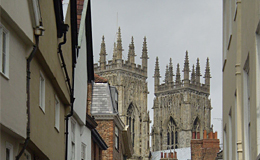
York Minster (see above)
As churches go, York Minster is somewhat special. It too has its share of ghostly history, including a very poignant story. A man, B.L., was visiting the Minster and talking to a friend and his two daughters. Another man, wearing a naval uniform, walked towards them. One of the daughters went very pale. The navy man then whispered to the woman: ‘There is a future state,’ he said, before vanishing down the aisle of the Minster. B.L. tried to find where he’d gone, without success, but the daughter then made everything clear. The man, it turned out, was her brother, who had just died at sea. They’d made an agreement, whoever died first would go to the other and show that life after death exists. And that’s what happened.
News came which confirmed her story, her brother had died on the very same day, at the same time, that she’d seen his presence, standing there in the north aisle.
 Cleeve Hill (Cheltenham)
Sometimes, just to be near to a church is enough for a haunting.
Cleeve Hill is the highest point in Gloucestershire and the Cotwolds, being a little over 1000 feet above sea level. A teacher, driving down from the Hill, saw a funeral procession making its way across a field, close to the road. She noticed the cortege was moving slowly and was rather smart, but couldn’t see why it was crossing the field, instead of using the easier road. She also saw men accompanying the hearse, dressed in black, but slightly wobbly, and laughing a lot. She didn’t know this was a Victorian funeral.
In Victorian times, a cortege might take a different route to the usual one, to keep spirits away from the living. And as for the men, attendants might have a little gin, and sometimes too much, and so become tipsy.
The woman was intrigued by the unusual sight, and turned her car round, wanting to see more. But she was too late, the procession had gone, and far too quickly in such a short time… unless of course she’d seen a ghost. St Peter’s Church overlooks the site, perhaps the funeral had come from there. The teacher had unpleasant dreams of Victorian faces for months to come.
St Andrew’s, Langenhoe (Colchester)
This church was demolished in 1962 but was once one of the most haunted in Essex. The vicar, Ernest Merryweather, appointed to the church in 1937, always kept a diary, and soon used it to record ghosts. The church was plagued with many incidents, including one where labourers heard the sound of chanting, sung in French, in an empty church. The Reverend also saw a woman, the same woman, on two occasions, but two years apart (1949 and 1951). The first time, she vanished into a place where a doorway had been, through an internal tower wall. Merryweather hadn’t known the door existed. The second time she vanished through St George’s statue, which was placed in front of what had once been the door.
A year later, Merryweather was in the middle of a service, when he spotted a woman who suddenly vanished – the woman looked sad, and might have been someone different from before. Weeks later, he heard a noise and thought from the sound that the tower was collapsing. It wasn’t. There were other things too. These included the church door slamming, a man’s footsteps, a woman exclaiming ‘Ow!’ (twice) and a hideous smell.
The church had not had an easy history. It was struck by an earthquake in 1884, and this had damaged the building badly, although even before, the tower was said to be in a vulnerable condition, and had been compared to the leaning tower of Pisa. After the earthquake, the church was rebuilt, but it didn’t survive another century. After Merryweather left in 1959, the church was no longer used for prayers – apparently because it was too dangerous. But dangerous why – because of its structure – or because of the ghosts inside the building?
 And finally, back to Charlotte Brontë. George Hauton of the Brontë Society is on record (see details of YouTube video listed below) as sensing Charlotte’s spirit in her old church in Haworth. Or rather, in the church that replaced hers in the late nineteenth century. It seems that churches come and go – but the ghosts live on…
Sources
- Ackroyd, P The English Ghost, Vintage, 2011
- Barham, A Lost Parish Churches of Essex, Ian Henry Publications, 1999
- Mitchell, J V Ghosts of an Ancient City, Cerialis Press, 1974
- White, D Haunted Cheltenham, History Press, 2010
- YouTube video – Charlotte Brontë 1 of 2: Ghosts & Lost Photos
Sources of Images
- York Minster from Low Petergate
- Road to Cleeve Hill © Philip Halling
- St Michael and All Angels Church, Haworth © Dave Green


